How to build a YouTube content team in Dubai and find video ideas
Build a YouTube team in Dubai: divide editorial decisions and coordination, prepare a topic card and review work across several suppliers.
In this article (11)

To publish YouTube videos regularly, assign the work from topic selection through to reviewing a published video. One person can cover several roles in a small team. Start with the stages where videos are delayed: they help identify whom to hire first and what the business owner is ready to hand over.
Consider a company that already has an editor and camera operator, while the owner spends evenings choosing topics and gathering feedback. Another production hire may add capacity without reducing that workload. Someone needs responsibility for preparing the content and approving the video, with clear decisions reserved for the owner.
I’m Ivan Zinovev, founder of iZi Media. I build and develop content teams, work locally in Dubai and also run remote projects. Here I will describe a model for a business or expert who needs regular YouTube videos, short-form content and a useful supply of ideas.
Which roles does a video need?
In a small team, one person may handle several stages. List their responsibilities and check whether they have enough time for the agreed volume. The list will show which work a new hire should take on.
| Role | Responsibility | What moves to the next stage |
|---|---|---|
| Producer or content lead | Audience, topics, format, priorities and video quality | Approved brief and decisions |
| Writer or editorial lead | Material, questions, script and fact-checking | Video outline and sources |
| Camera operator | Picture, sound and recording arrangements | Footage and recording notes |
| Video editor | Story, pacing, sound and graphics | Review version and final files |
| Designer | Thumbnails and visual material | Files in the agreed formats |
| Publishing owner | Uploads, descriptions, links and presentation | Published video and publication checks |
| Analytics owner | Viewing data and its relationship to enquiries | Findings and changes for future videos |
The producer or editorial lead often handles publishing and analysis too. A filming crew can join on specific days. Check the arrangement against the workload: number of videos, editing complexity and the number of people involved in approvals.
Agree the owner’s tasks too: providing material, checking important wording and appearing on camera. Establish which decisions the producer can make independently. Otherwise, every stage may still wait for the business owner.
When you need a coordinator and when you need editorial leadership
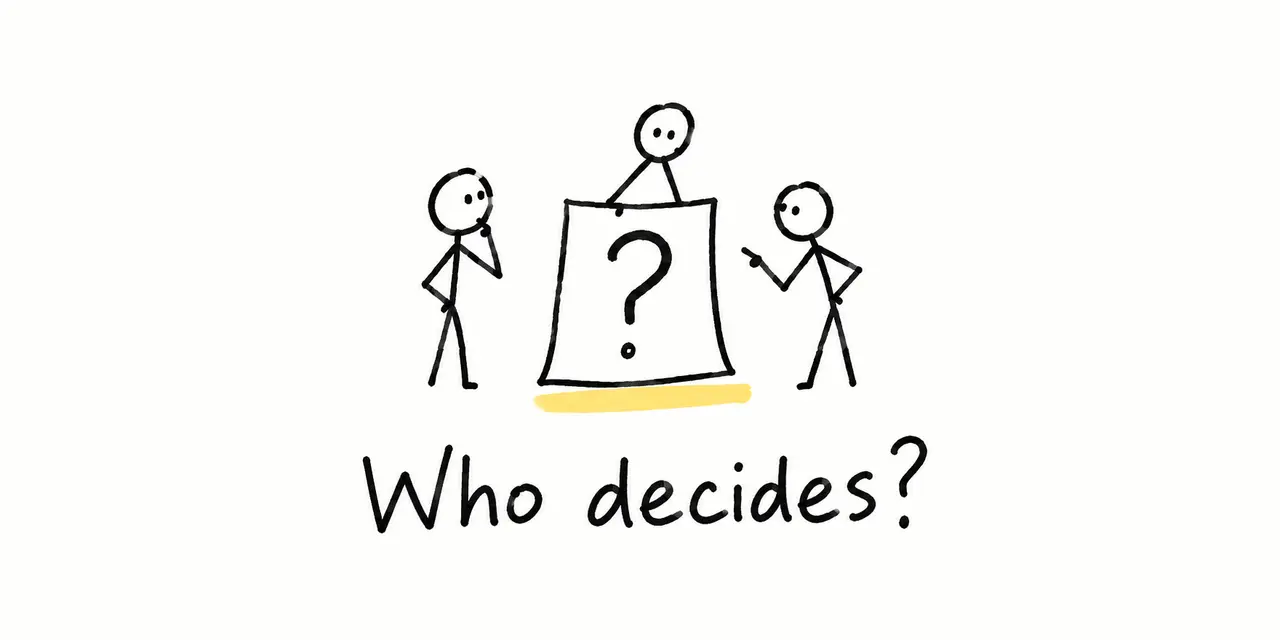
A coordinator manages the calendar, gathers files and follows up on replies. That can be enough when the topic, structure and acceptance criteria are settled and someone is available to resolve content questions. If people are waiting to learn who the video addresses, which example to keep or what the title promises, appoint someone with authority to decide. More reminders alone will not make those decisions.
A producer can combine both functions in a small team. Agree their authority and test it on one video. Specify what they can decide, what returns to the expert and when a change of scope requires a new discussion of timing and cost.
| Decision | Who prepares it | Who approves it |
|---|---|---|
| Viewer question and topic | Editorial lead using sales and expert material | The appointed head of content |
| Facts and conditions of a recommendation | Subject expert with sources | The person responsible for factual accuracy |
| Answer sequence and cuts | Editorial lead and video editor | Head of content; changes of meaning return to the expert |
| Readiness to publish | Editorial lead checks the final file | The person authorised to publish it |
| Rescheduling and file handover | Coordinator proposes the arrangement | People responsible for the affected stages |
Names can repeat in this table. Where two people share a decision, specify who consolidates feedback and how disagreements are resolved. For an external producer, agree these boundaries in a pilot with an agency or in-house team.
In-house team, external production company or a mix?
An internal team is useful when content draws on the company’s everyday work. Writers hear client conversations, can get quick expert comments and notice stories inside the business. The company also needs time for management, hiring and training.
External production suits an agreed volume of deliverables when someone inside the business can provide material and approvals. Clarify how much preparation the contractor handles and who on the client side can answer questions.
A mixed team is another option. An internal expert or editor collects material, a local crew films in Dubai, and remote specialists handle editing and thumbnails. The producer connects the stages and owns the video.
| Model | When it can work well | Workload to account for |
|---|---|---|
| In-house team | Ongoing access to people and company material | Management, hiring, utilisation and training |
| External channel management | Agreed deliverables and a clear owner | Providing evidence and approving material |
| Mixed team | Internal expertise with specialist production roles | Handoffs between participants |
Compare costs across the full cycle. Include salaries or contractor fees, filming, tools, storage and the manager’s time. Use the same volume to compare models. The budget breakdown is in choosing a YouTube producer and video production team.

Who should you hire first?
Look at where the video waits most often. If the material and recording are ready but the edit takes weeks to start, examine the editor’s workload and brief. If the operator is available but topics are invented the evening before filming, consider a writer or producer.
For a new channel, I first discuss who will handle preparation and content decisions. We then work out the recording and editing volume. Before hiring those specialists, establish where their source material will come from.
During an interview, give the candidate a specific task to discuss. A writer can examine a customer situation and your material. Show an editor a recording extract and explain what the viewer needs to understand. Ask a producer to plan one video with you.
Keep a paid trial limited in scope. Agree the deadline, use of the result and acceptance criteria. For a writer, assess factual accuracy and clarity of the outline. For an editor, assess preservation of meaning, sound and fulfilment of the brief. For a producer, examine their decisions, questions to the expert and organisation of handoffs.
Experience in a similar field helps, especially when precise wording matters. During the task discussion, notice whether the candidate spots gaps and asks follow-up questions. Ask them to explain one choice: what would they keep in the video, and why?
Where can a content team find video ideas?
Begin with sales and the people delivering the service. Ask about questions before purchase and situations where they had to explain a choice in detail. Those conversations can provide both the topic and material for a video.
Ask them for specific examples. What did the person ask? What were they choosing? What caused uncertainty, and what did you have to explain? Preserve the customer’s language while removing personal details. It helps you name the topic accurately.

| Source material | What to look for | What it can become |
|---|---|---|
| Sales conversations | Questions before a decision | A comparison or explanation of a choice |
| Expert practice | Recurring situations | A breakdown with examples |
| Completed project | Decisions and their consequences | A story about the work |
| Video comments | Follow-up questions and different perspectives | A continuation of the subject |
| Videos in your field and adjacent fields | A useful way to explain or show something | Your own format using your own material |
| Channel analytics | Topics people choose and watch | The next video for that audience |
When reviewing another creator’s video, distinguish the subject from the way it is told. What helps viewers follow the explanation: a comparison, someone’s story, an experiment or access to a location? Then check whether you have your own material for a similar form.
For example, suppose someone in another field shows a working day in detail. You could use that format for a day preparing a project, provided it contains decisions worth explaining to your customer. Your actions and selection criteria supply the material. Another creator’s success alone cannot tell you whether the format will work on your channel.
Turn a broad topic into a specific video
Narrow “content for business” to a situation: an owner is hiring their first editor and preparing a handover. The video can answer their immediate question: what should they send so the editor understands the task?
“What to give an editor before the first video” could show the footage, brief and examples of editing notes. Viewers can use it to prepare their own brief and agree an approval process. I discuss an example in a brief an editor can use.
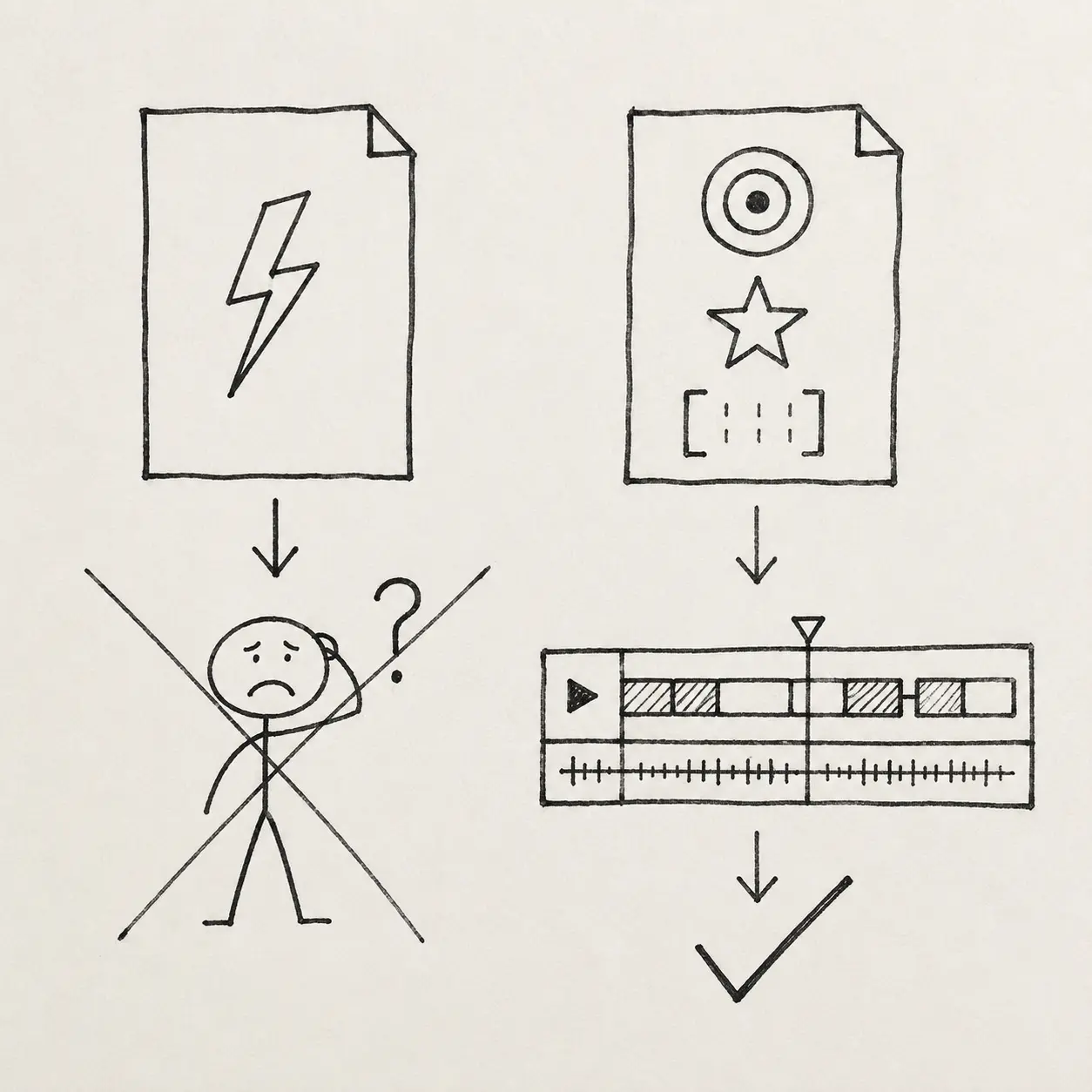
Use a short card for each idea. Include the person and situation, video promise, supporting material, working title, thumbnail concept and next step. The card helps you choose what to record and gives the writer a concrete starting point.
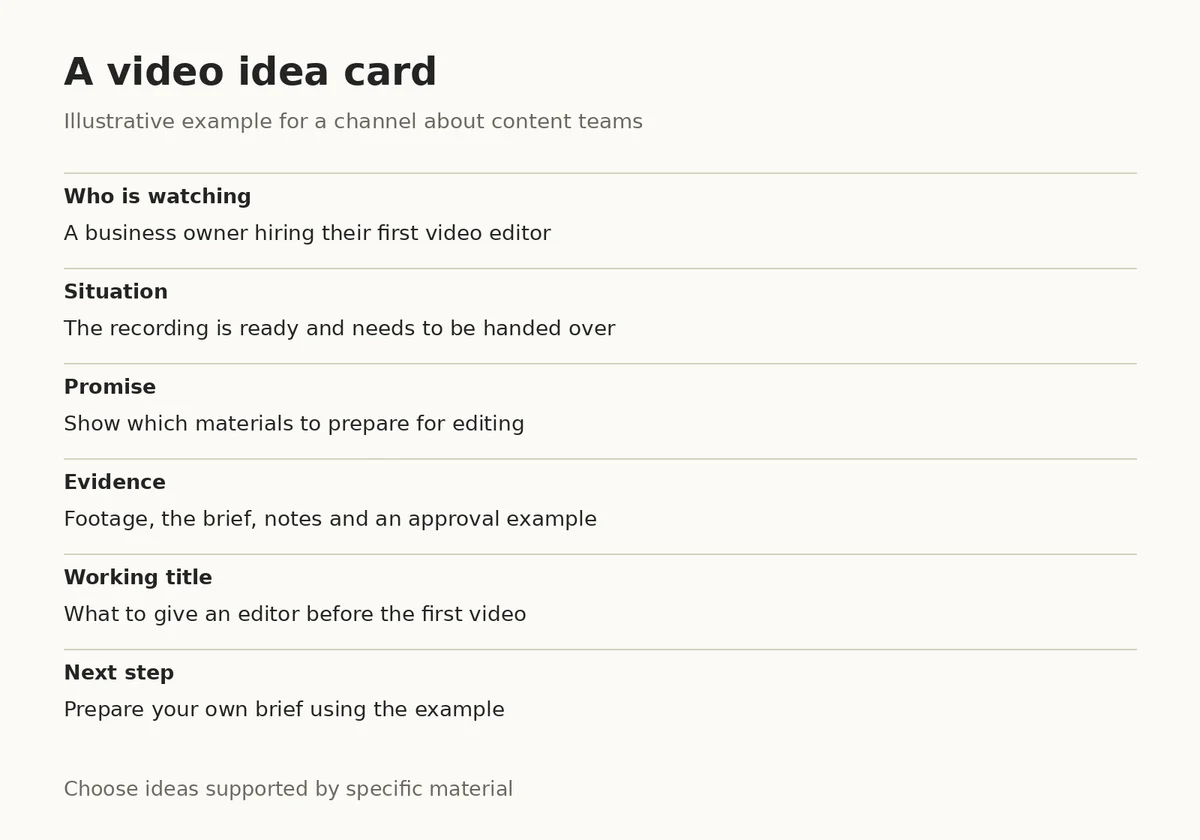
Before handing an idea to the writer, check that the material supports the explanation you have promised. Find the actual calculation if one is needed. Interview the expert if their decision is unclear. This exposes missing material before filming.
A completed topic card
Continue the illustrative example of hiring a first video editor. This card helps decide whether the idea is ready to develop. It does not report the outcome of a particular client project.
| Card field | Example entry |
|---|---|
| Viewer and situation | A founder hands a recording to a remote editor for the first time |
| Question | What should accompany the footage to support a meaningful first cut? |
| Explanation | Connect the viewer’s question, the relevant answer and an example in the recording |
| Source material | A cleared passage, timestamped transcript and illustrative brief |
| What to record | The expert highlights the answer and explains the sequence of passages |
| What to verify | Quotes exist in the source and cuts preserve their conditions |
| Next step | The viewer prepares a brief for their own recording |
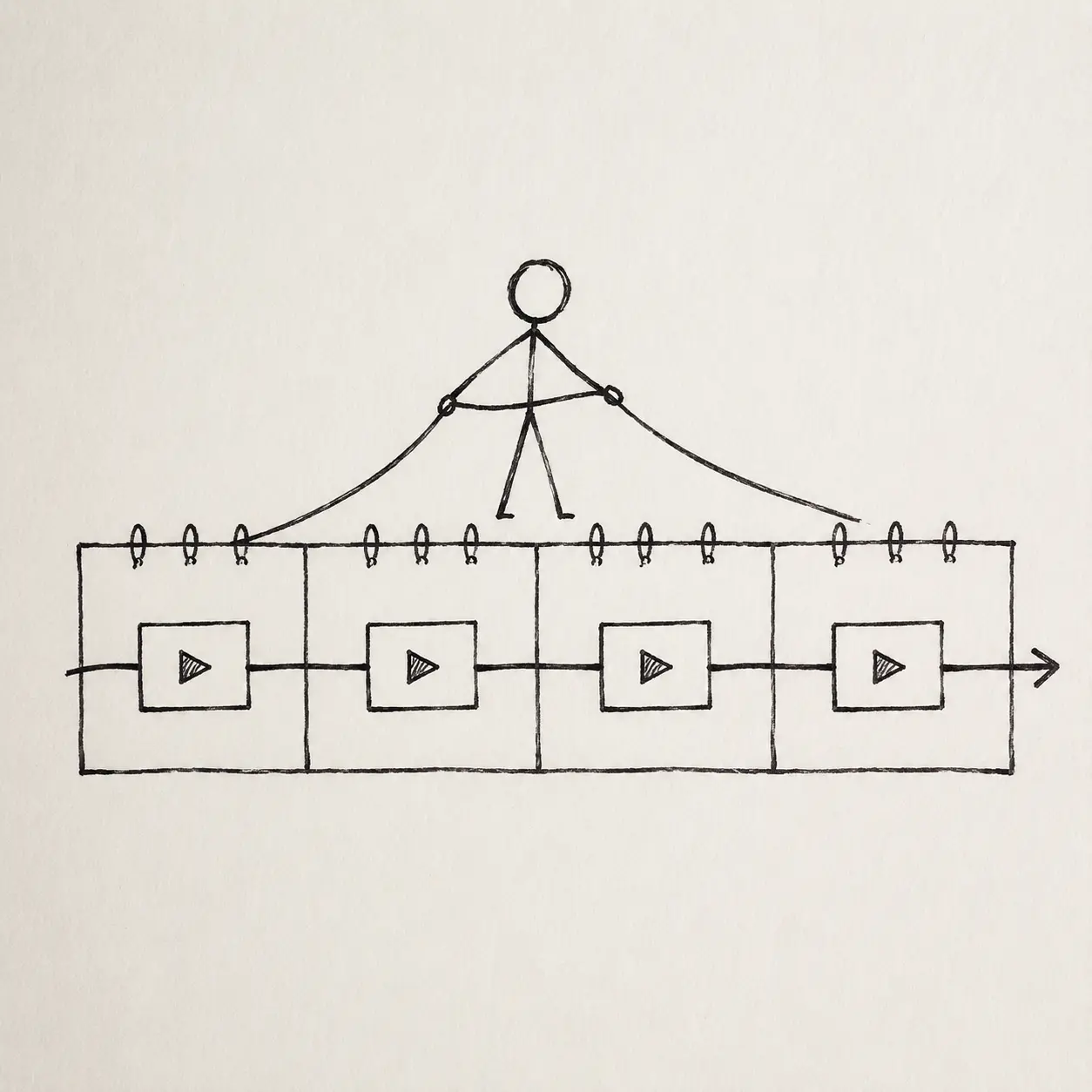
If the source material is missing, keep the card in preparation. Before filming, the head of content checks that the available material can fulfil the video’s promise. The editorial lead then develops the outline and the coordinator schedules recording. The week-by-week production guide covers the approval process.
Sample topics for businesses and experts
These are starting points for an editorial meeting. Specific numbers, outcomes and title promises belong in the video once the material has been checked.
| Field | Possible topic | What makes it specific |
|---|---|---|
| Dubai real estate | How to compare neighbourhoods around your daily journeys | Real routes and a particular person’s criteria |
| A high-value service | What makes up our project estimate | Actual work and terms |
| Consulting | How we examine a client’s task in the first meeting | A sample discussion and resulting decisions |
| Online education | What a student can do after one lesson | An exercise and an observable outcome |
| Expert channel | One situation from practice, explained in detail | Checked facts and material cleared for use |
| Sales team | Questions customers ask before paying | Wording from real conversations |
| Content management | How we prepare four videos for one shoot | The team’s documents and actions |
| Personal brand | The decision that changed my approach | The author’s experience and its consequences |
Choose what viewers can watch after each video. A video about choosing a service can lead to a breakdown of a relevant project. The series can then answer successive questions from the same person.
For a new channel, choose a few related topics and observe one audience. If every video addresses a completely different person, it becomes harder to understand the interest and choose the next piece.
How to hand work from one person to another
The writer needs the viewer’s situation, expert material and video promise. The operator needs a recording plan and a list of things to show. The editor needs footage, structure, important passages, references and delivery requirements. The designer needs the idea, agreed title and thumbnail material.
Keep these together. Give each video a page or task with the current script, footage links, deadlines and owners. State which version is approved and what happens next. This is particularly useful when the team works from Dubai and several other cities.
Gather feedback through one responsible person. A useful editing note includes the timestamp, action and reason. For example: “At 02:14, add the calculation on screen so viewers can see which amounts make up the total.” The editor understands the intention and can suggest how to execute it.
Before publishing, check sound, meaning, names, facts, thumbnail, description and links. Assign an appropriate specialist to review sensitive claims about health, law or finance. Agree publishing authority and channel access in advance.
Review an error across several suppliers
Suppose an illustrative comparison loses a condition during editing and that condition changes the conclusion. Open the approved outline, original recording and final file. If the condition was in the outline and footage but disappeared in assembly, the correction concerns editing and final review. If it was never recorded, return to preparation or filming. A job title alone does not establish responsibility.
Record the correction, its owner and the version to review again. After replacing the passage, also check captions, the title and short versions: they may repeat the same inaccurate conclusion. The appointed publishing lead gathers the specialists’ replies and accepts the finished version.
Agree this process before recording when several suppliers are involved. Define which work corrects an error and which constitutes a new client request. Decisions about additional work and payment should follow the agreed scope. Use the editor’s brief guide for handover and the production with your team to discuss the team’s structure.
How can you tell whether the team is improving?
Separate production measures from channel performance. In production, count completed videos and time waiting between stages; note repeated approvals. For the channel, examine what viewers choose, how they watch and whether they return. Track enquiries separately.
If editing speeds up while meaning gets lost, review the brief and finished-version checks. If more videos attract a different audience from the one you need, revisit topic selection. Examine an improvement in one stage alongside the outcome of the video.
At the review, open a specific video alongside its data. Compare its promise with viewing behaviour and audience questions, then decide what to change next. YouTube explains key metrics in its content performance guidance. Add the company’s enquiry and sales records.
Keep the brief version and the resulting decision: what you changed for the next video and why. Training can then draw on the team’s own work.
How to use AI within a content team
Choose one recurring task and test it on real material. Finding standalone Shorts within a long interview is a useful example. First, the editor marks suitable passages. Then compare that selection with the tool’s: which stories did it find, where did context disappear and what needed correcting?
Here is an instruction for that trial:
Suggest passages for short videos from this transcript. For each, give the exact timestamp, viewer question, speaker’s quote, clear conclusion and context needed at the beginning. Identify references to earlier remarks and facts requiring verification. Use only information from the supplied material.
Check the response against the recording. An automatic transcript can get a number or name wrong. A passage may lose the question that gives the answer its meaning. Verify the timestamp too. The editor’s handoff card should contain the checked quote, source and editorial decision.
| Task | Tool output | Check before the next stage |
|---|---|---|
| Finding topics in an archive | Ideas with source references | A usable example and current information |
| Preparing Shorts | Passages with timestamps | Whether the point makes sense outside the long video |
| Drafting a script | An outline based on expert material | Evidence for each claim and the expert’s own voice |
| Translation | A second-language version | Meaning, terminology, names and natural language |
| Analytics review | A summary and possible explanations | Period, traffic sources and original numbers |
Count all time spent on the task, including checking and rework. If correcting invented details takes longer than the first draft saves, change the input or choose a different task for the tool.
Assign responsibility for permission to process material, fact-checking and final approval. Save a successful instruction, an example result and acceptance criteria in the shared workspace. The next person can repeat the task and understand what counts as ready. Team training can use examples like working with an expert archive and the tasks covered in iZi Media training.

Questions about teams and ideas
How many people does a YouTube channel need?
Assign the roles first: content, recording, editing, packaging, publishing and analysis. One person can cover several roles. Headcount depends on the volume, complexity and time available.
Can the whole production team work remotely?
Preparation, editing, design and much of the management can be remote. For recording, establish who helps the speaker locally and checks the equipment. Keep material, deadlines and feedback in a shared workspace.
How do you find ideas for an expert channel?
Collect customer questions, situations from practice and decisions between options. For each idea, identify whom it helps, what they should understand and which example the expert can show. Select topics with material already available.
What if a team exists but the owner still manages every video?
Agree which decisions the owner wants to keep and which they can hand over. Appoint a video owner and set quality criteria. Test one full cycle, then adjust responsibilities from the experience.
Discuss the team you need
Send the current team list, planned volume and stages where videos are delayed. At iZi Media, we can discuss who should take on that work and how to organise videos. Contact me through the production with your team page.
For a channel launch, read starting YouTube for business in Dubai. To choose external help and compare quotes, continue with choosing a YouTube producer and production company.