HomeArticlesYouTube lead generation
YouTube lead generation for businesses in Dubai
Connect YouTube with enquiries in Dubai: buyer topics, videos before a sales call and a sample CRM log. Track clicks, messages, qualified leads and sales.
In this article (12)
YouTube lead generation starts with buyer questions, a relevant offer and records that connect enquiries to sales. A few thousand views may start a useful customer conversation; a hundred thousand may produce no WhatsApp messages. To understand either result, a Dubai business needs to know who watched and what happened after the video.
Start with the service you want to sell and describe the buyer you want to reach. Choose topics where you can demonstrate the work, then give viewers a specific reason to contact you. This guide explains how to connect those episodes to enquiries and production costs. For a Dubai business, record the buyer’s language and project location too: some viewers may be outside the UAE.
Define the enquiry you want
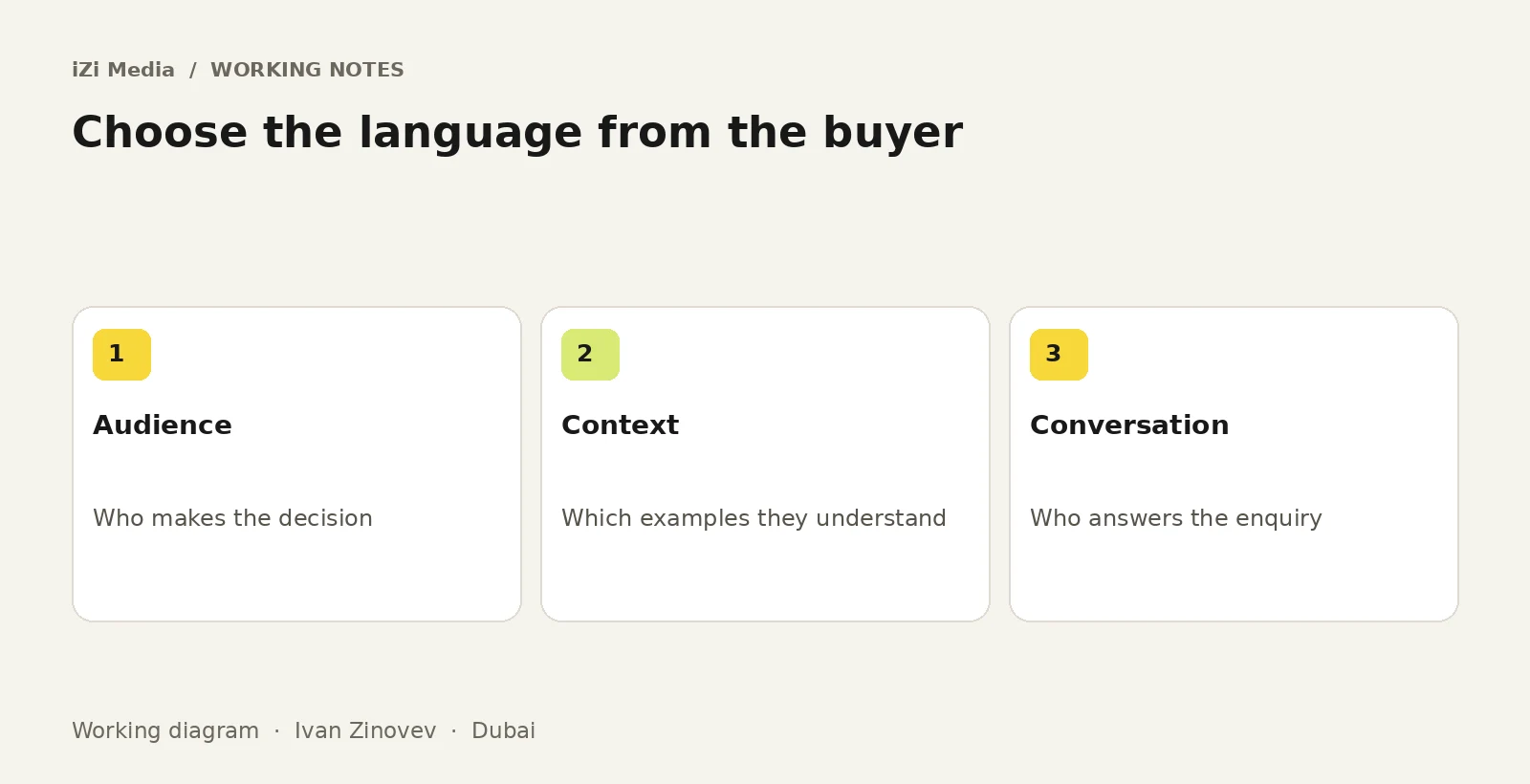
Agree which enquiries the sales team should qualify. A property agency might require a stated budget, timeframe and purchase purpose. A production company might look for a founder with a clear channel objective who is ready to discuss scope. A consultant needs to know whether the question fits their expertise and service. Editors can use the same criteria when choosing topics.
Write the criteria before the first episode. For example: “A business owner who wants to record regular expert videos in English, can contribute to preparation, and is looking for a team for several months.” The editor now knows who to address. The person answering messages can distinguish a relevant enquiry from a request for an unrelated service.
A company offering several services needs several descriptions. Someone buying a one-off shoot and someone commissioning ongoing channel production have different expectations. One video might introduce both to your work, but its invitation should connect to a specific offer. Otherwise the viewer writes “How much?” and the sales conversation starts from scratch.
Dubai adds a useful distinction: the creator, viewer and eventual project may be in different places. A Russian-speaking founder might be preparing to relocate and looking for a local producer. An English-speaking viewer might already be in the UAE and want a remote team. Record communication language, current country and project location separately. A single “Dubai” field mixes these situations together.
Choose topics around the buyer's decision
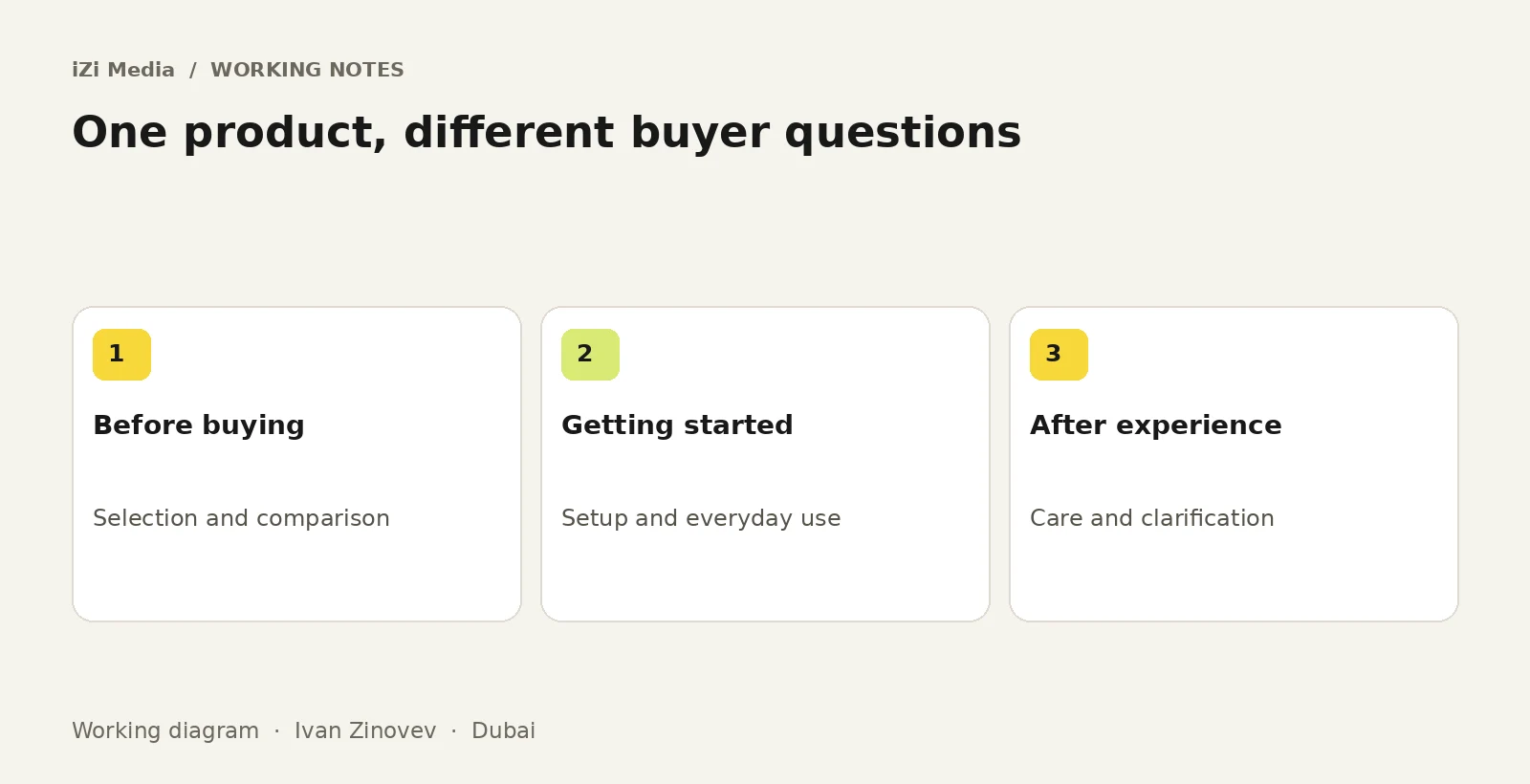
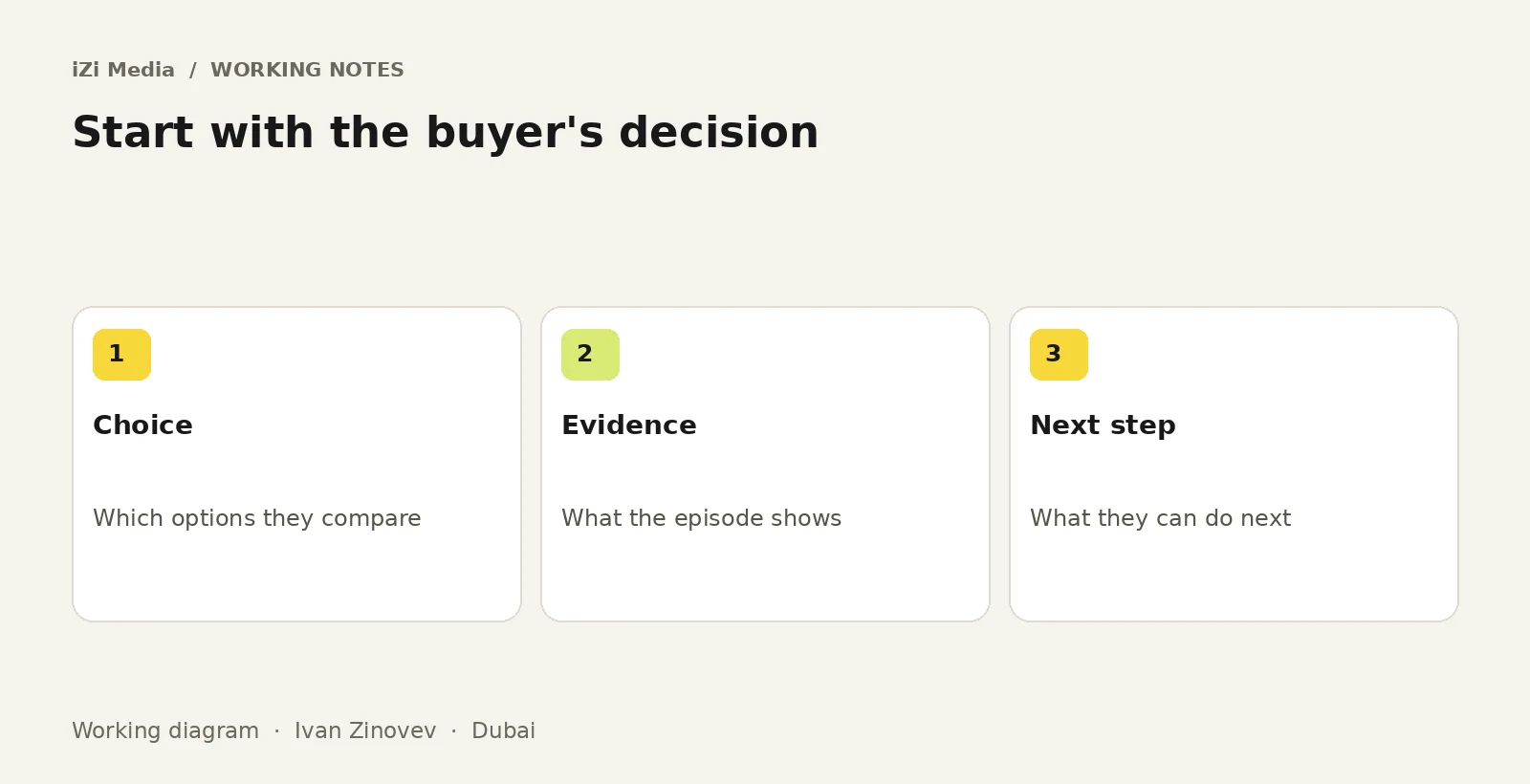
List the decisions buyers bring to you. They may be comparing two quotes or working out how much preparation a shoot requires. Either question gives the episode a concrete job: explain the relevant conditions and show what the buyer should check. Choose a working title once you know what the episode will help someone decide.
| Viewer situation | Episode topic | Evidence to show | Next step |
|---|---|---|---|
| Choosing a supplier | How to compare two filming quotes | The same brief and differences in scope | Send a project for assessment |
| Preparing a launch | What to prepare before the first shoot | Expert materials and an example plan | Discuss a first episode |
| Getting views | Why videos produce few enquiries | Topic, offer and contact journey | Review their viewer journey |
| Building a team | How to review an edit efficiently | Acceptance criteria and sample feedback | Assess the team's process |
Each row connects a subject to a service through a specific buyer question. Broader, more entertaining episodes can introduce the business. Someone already choosing a provider needs enough detail to compare offers. Review the responses to see which material reaches suitable viewers and which questions remain unanswered.
Consider a hypothetical founder who wants an interview recorded. “How to become more visible” attracts a wide audience. “How to prepare for your first filmed interview” addresses their immediate situation more closely. Show a rehearsal of one answer, a sample question, and how you collect supporting material. The viewer can assess the work behind your offer.
Build the episode around evidence people can understand
Make the work visible through a quote, diagram, edit or rehearsal recording. For example, showing an original answer beside the prepared version lets a viewer assess the editor’s contribution. Choose that material with the topic. If a client example cannot be shared, prepare a demonstration and clearly label it as such.
For an episode about production costs in Dubai, work through a hypothetical project: one expert, one location, several episodes and additional short versions. Show preparation, the recording day and the work afterwards. Use a current quote for actual prices. Viewers get a way to compare suppliers while seeing how your team thinks.
Explain the customer’s part in the project: what materials they provide, who approves the script and how much time is allowed for approval. If the speaker can record only once a month, explain how that affects the proposed schedule. Buyers can then judge whether the arrangement is workable before they enquire.
Connect the invitation to what the viewer learned
“Contact us” asks viewers to invent a reason and a message. Name the action and explain what happens next. After a quote comparison, invite them to share their objective and intended scope. After a preparation episode, offer to discuss a first recording. After a team episode, ask for their current workflow.
An example: “If you are planning an expert channel in Dubai, send your business topic, audience language and a format you like. We can use that to discuss the team and preparation.” Agree on the invitation with whoever answers incoming messages, so they can actually continue the conversation.
Place the invitation where viewers have enough information to act. After comparing quotes, you could invite them to send a project for assessment; at the end, remind them what to include. Three calls to action per episode are not a requirement. Frequency should fit the length of the video and the discussion at that point.
Follow the video link on a phone and try to start a message. Check the page language, service description and contact method. If a form asks for a long brief before the first conversation, confirm that the person handling enquiries needs every answer at that stage. Questions that can wait should not hold up initial contact.
Record clicks, messages and qualified enquiries separately
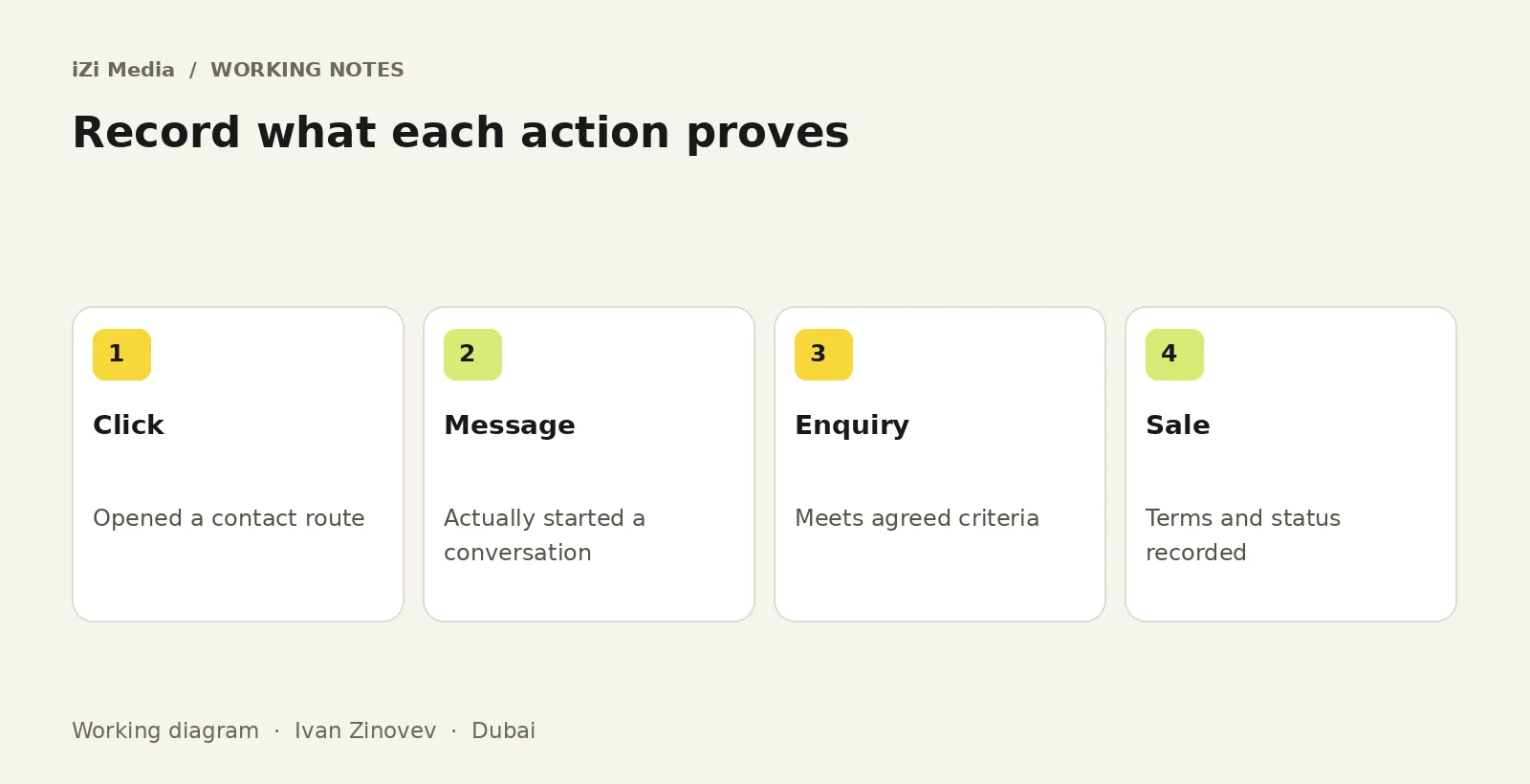
A Telegram button event records an attempt to open the messenger. The viewer may close the app, get distracted or contact you elsewhere a week later. Record the visit, actual conversation, qualified enquiry, meeting and sale as separate stages.
| Stage | Record it in | What it confirms |
|---|---|---|
| Link visit | Website analytics | The target page was opened |
| Contact click | Button event | An attempt to open a contact channel |
| Message | Conversation or CRM | The person actually wrote |
| Qualified enquiry | Customer record | Agreed criteria were met |
| Meeting | CRM or calendar | A conversation was booked or held |
| Sale | Sales records | Agreed terms and a defined payment status |
If lead_created fires on a button click, label it as a contact click in the internal report. Compare those clicks with actual messages. Where few people reach a conversation, test the contact link and review the offer on the page. Where conversations start but stop, read the replies the buyer received.
Use agreed UTM names for episode links. An illustrative convention is source youtube, medium organic_video, series founders_en, episode briefing_01. These tags identify website visits if your analytics collects them. Messenger conversations can lose the connection to the original session. Ask during the first conversation: “How did you find us? Which video did you watch?”
A few CRM fields are enough to start: first-message date, source reported by the buyer, episode or series, language, objective, qualification status and next-contact date. Preserve the initial source separately from the latest touch. Someone may discover you on YouTube, return through a search for your name and then write. The latest visit explains website entry; the discovery history explains content's role.
A record of one enquiry
The following fictional history illustrates record keeping. Use an internal contact identifier in the working log. Share only the anonymised details needed for editorial review; names, phone numbers and complete private conversations are unnecessary for choosing a topic.
| When | Event | What to record |
|---|---|---|
| Day 1 | Contact A01 writes for the first time | Objective not yet clarified; they name YouTube as the source but no episode |
| Day 2 | The same person describes the project | The enquiry meets the agreed criteria; update A01’s status |
| Day 2 | They mention a quote-comparison episode | Record the client’s account; completion of the video is unknown |
| Day 5 | They write through another messenger | Add a touch to A01 after confirming the contact matches |
| Day 9 | A project conversation takes place | Record the meeting and next action; contract and payment remain unconfirmed |
In this example, one enquiry becomes qualified and reaches a meeting. A repeat message does not create another lead. If the relationship between two conversations is unconfirmed, keep it unknown until clarified. A shared question topic alone is not enough to merge people.
Keep contact-button clicks in separate visit statistics. Without a reliable connection, you cannot attribute a particular click to A01. If the person later names YouTube, add the client-reported source while preserving the earlier record. Distinguish a known source, a possible contribution from the channel and missing information.
Read YouTube Analytics alongside sales conversations
Impressions CTR measures views following registered YouTube impressions. Its value depends on audience and traffic source. YouTube explains that some external views sit outside that calculation. Comparing two overall percentages without context can therefore mislead. See YouTube's impressions and CTR guidance.
A high CTR on a small sample may reflect interest from familiar viewers. A falling CTR as impressions expand can accompany reach into a broader audience. First check traffic source, time since publication and sample size. Then compare similar episodes at the same age.
Retention identifies moments worth reviewing. Watch the actual recording around a drop: did the subject change, an extended introduction begin, or an advertisement appear? One graph permits several explanations. Review the segment and compare similar episodes. See YouTube's audience retention documentation.
Add the substance of sales enquiries. After an episode about quotes, for example, check which terms buyers already understand and which still need explaining. Relevant enquiries from a small audience may indicate that the topic is doing its job. Broad reach among people seeking free help with a different problem gives you a reason to revisit the topic or offer.
Use a video before the first conversation
Once someone has enquired, choose a piece around their remaining question. Before discussing a quote, send a scope explanation; before an interview recording, send a guide to preparing a first answer. Explain which part concerns their project and invite questions. Watching should not be a condition of the first conversation.
Record which video was sent and why. Later ask whether it clarified the issue and what remains unclear. A sent link confirms the salesperson’s action; it does not establish viewing or an effect on the purchase. Keep the answer if the client says they did not watch.
For a property agency, comparing options around a buyer’s situation may be a useful continuation. For your own offer, choose an explanation that actually helps someone prepare for a conversation. Recurring questions afterwards suggest which material needs clarification.

Calculate economics using your own business model
Take an illustrative month. Production costs 12,000 AED. Eight qualified enquiries arrive. Two sales generate a combined 18,000 AED contribution after direct fulfilment costs, before content production and other overheads. Cost per qualified enquiry is 1,500 AED. The difference between that contribution and the content budget is 6,000 AED.
These figures explain the arithmetic; they are hypothetical, with no claim to represent an iZi Media result or market benchmark. An economic assessment also needs team time, other expenses, cash timing and evidence connecting sales to YouTube. Track repeat purchases through the customer history. Show expected future payments separately from money received.
If sales take months to close, comparing costs and payments in a single calendar month distorts the picture. Track a group of enquiries arriving in one period through later meetings and payments. With few customers, one large sale strongly changes an average. Report the counts beside the ratios.
In our real estate lead-generation project, the first month included four long-form videos and twenty Shorts, with five leads and two clients reported for the project. This describes the output and result of that particular engagement. Assessing profitability would also require costs, margin and each enquiry's history; a new channel needs its own evaluation.
The case figures and account were supplied by me as the project’s producer. The contributions of long videos and Shorts to the five leads and two clients are not separated. Retain that limitation when using the example to choose a format or build your own model.
Test several explanations for weak results
Locate where people stop. Some viewers may be too early in their buying process, or the invitation may lead to an overly broad offer. For people who have already written, check response time and what they were asked to do next. Suitable buyers may also need more examples of the work before proceeding.
| Observation | What to check | First change to test |
|---|---|---|
| Views and relevant questions | Whether the service fits the viewer's task | A specific next step |
| Visits but few messages | Mobile page and contact channels | A shorter route to the right contact |
| Messages but few meetings | Qualification and initial response | Clear questions and response timing |
| Meetings but few sales | Offer, terms and reasons for declining | Review individual conversations |
Record each proposed change alongside the observation that prompted it. If viewers understand the service but struggle to start a message, test a clearer next step before changing the series. If they repeatedly ask for a different service, revisit the topic’s promise. Note what changed and what happened afterwards so the next review has something concrete to compare.
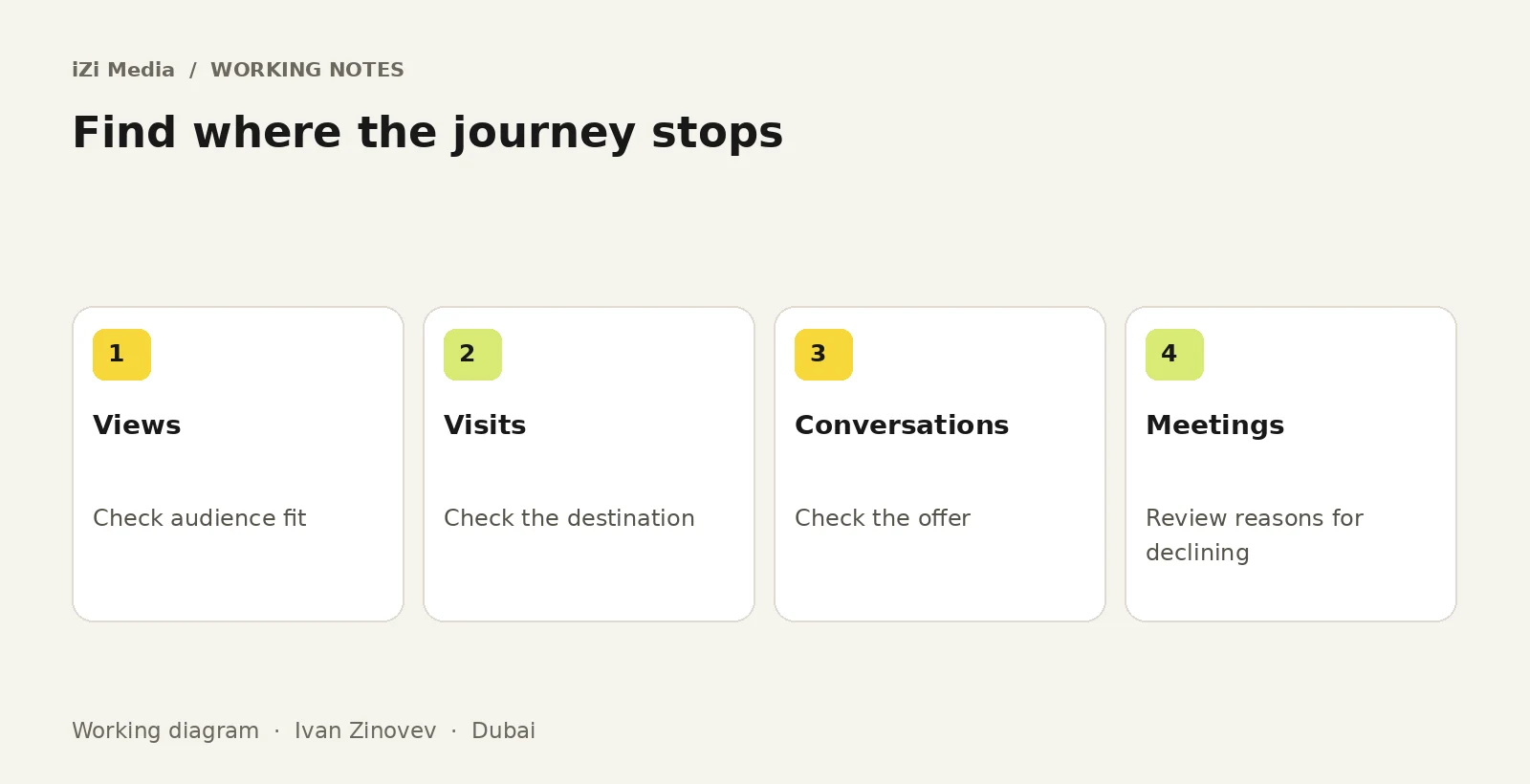
If qualified enquiries are scarce, examine alternative causes and select a check with the post-audit YouTube action plan.
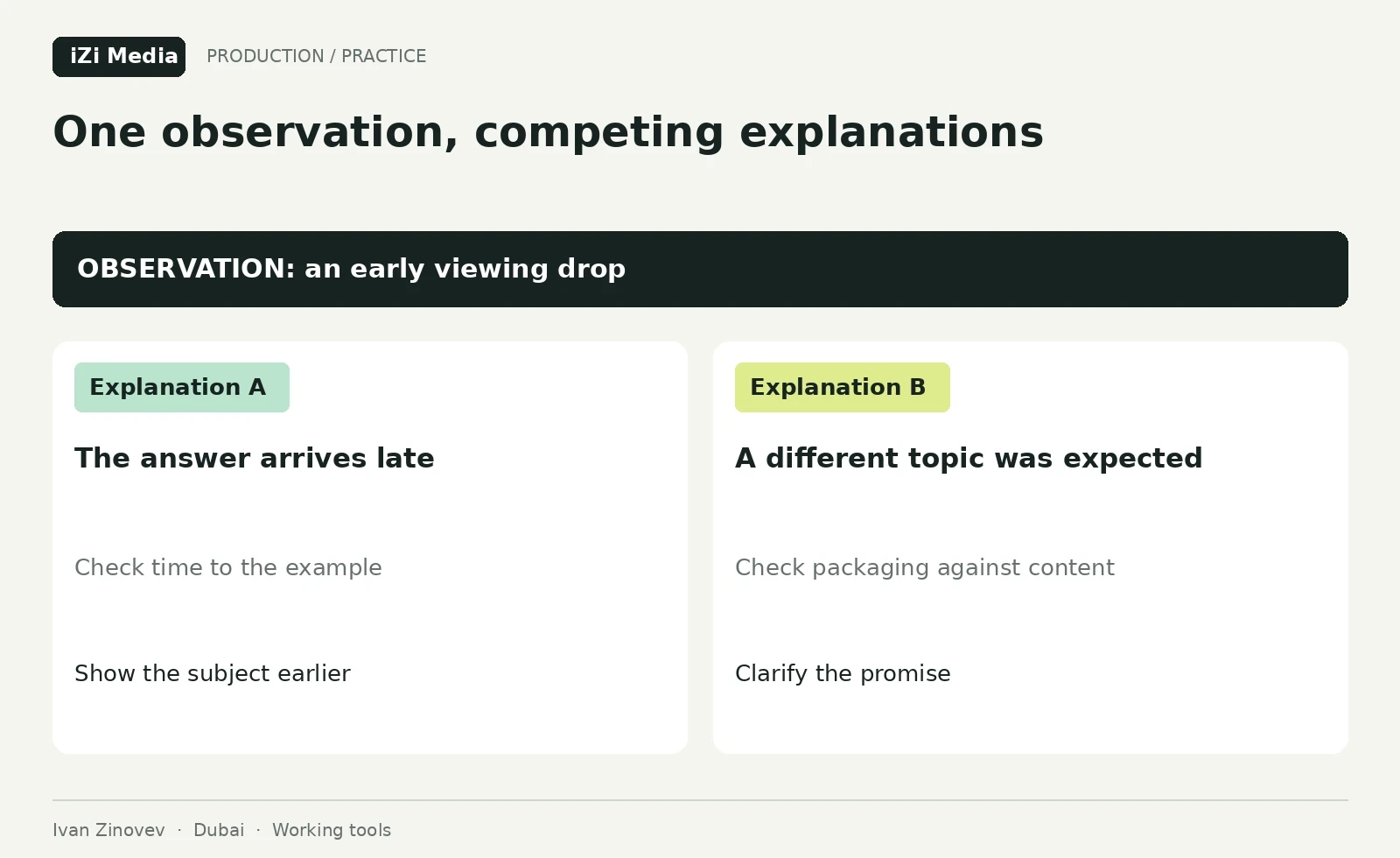
Use AI to organise questions and review drafts
AI can group anonymised sales questions, propose episode structures and flag unclear invitations. Give it the service description, audience and verified material. Ask it to distinguish a buyer's exact question from an editorial interpretation. Check the output against the conversations before accepting a topic.
An effective brief is: “Group these anonymised questions by the decision the buyer is making. Preserve original wording separately. Suggest an episode, evidence we need to show and a next step for each group. Mark missing information. Use only supplied facts.” The producer still decides which idea the team can substantiate.
Review numbers, claims and the status of examples manually. A fluent draft can change the meaning of a result or invent a connection between a video and a sale. For client documents, use approved services and remove unnecessary identifying details. A useful editorial example usually needs much less information than a complete customer file.
Plan a first working cycle
Start by defining suitable enquiries and reviewing recent sales conversations. Choose topics around those decisions, identify evidence and agree how messages will be handled. Record the first episodes with a clear invitation and prepare their destination pages.
After publication, compare the viewers reached with the visits, messages and sales conversations recorded. Ask customers which material helped and what they still needed to understand. Use those questions when planning later episodes. Choose the number of videos to fit your resources and what you need to learn; a fixed episode count cannot guarantee enough evidence for a reliable conclusion.
For a fuller review of an existing channel, use the business YouTube audit guide. When the audience spans languages, review the Russian and English channel planning guide before deciding how to split production.

Frequently asked questions
Can a small YouTube channel bring customers?
Yes, if it reaches people who need the service and gives them enough information to start a conversation. Check who enquired, what they wanted and whether the discussion progressed. View counts alone cannot establish the channel’s commercial value.
How quickly should a channel produce enquiries?
The answer depends on the service, audience, existing reputation and buying cycle. Agree what the initial series will test and when to review it. An early enquiry is useful evidence, but a few observations are too small for a stable forecast.
What should we measure first?
Record actual messages and qualified enquiries separately from contact clicks. Connect them to the buyer's task, language and discovery history. Then use video and website analytics to investigate where the journey needs improvement.
Do Shorts and long videos play the same role?
A Short may introduce one useful idea, while a longer episode can explain the conditions and show a worked example. Record which formats buyers saw and how they used them. That gives you evidence for the role of each format on your channel.
Continue the work
Use the Dubai channel launch guide to prepare the first series and the production team guide to allocate responsibilities. For businesses demonstrating physical products, see YouTube for product brands.


For a discussion about YouTube production in Dubai, describe the service and customers you want to reach. If you already have a channel, include recent buyer questions and which enquiries progressed. Send your project to iZi Media with those details so we can discuss where to start.