Before the sales call: what your YouTube videos should explain
Choose what to explain before a consultation, build a small video library for the sales team and assess whether it helps the conversation.
In this article (8)
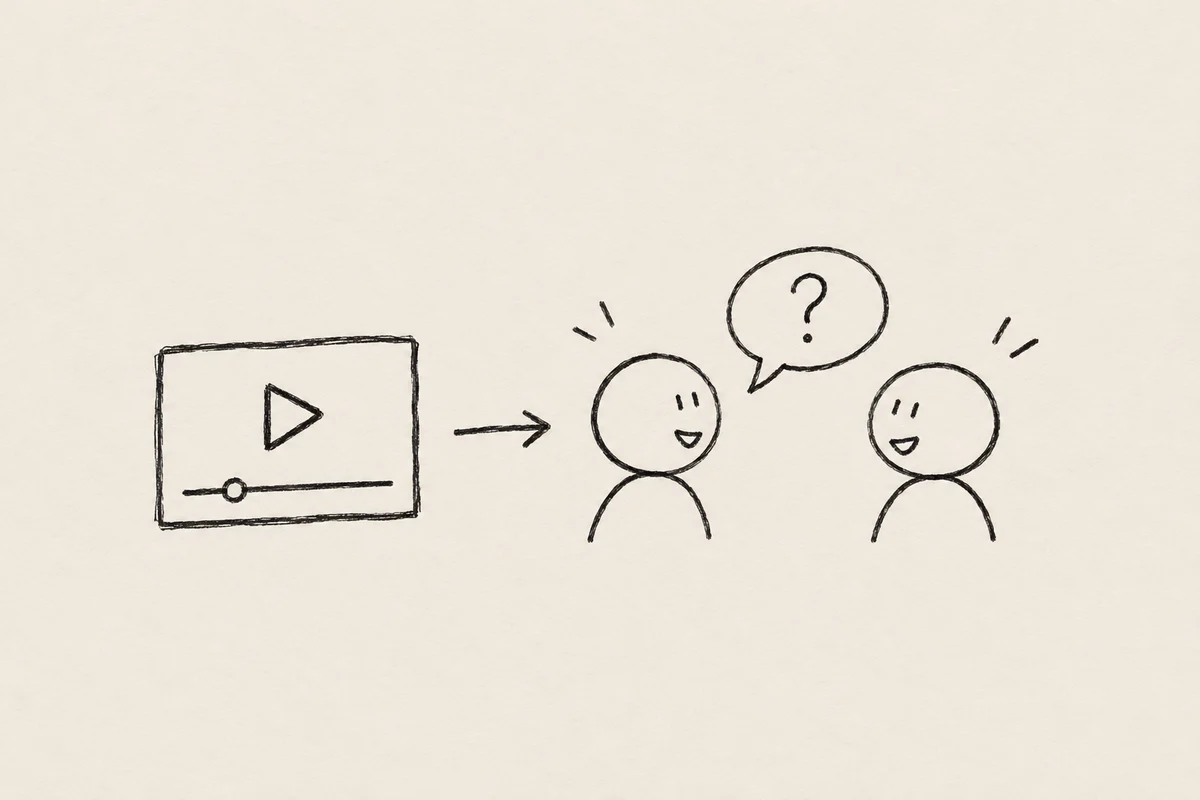
Another prospect meeting starts with the same explanations. What the work includes. How your approach differs. Why your price is higher than another supplier's. What you need from the client. When it makes sense to contact you.
That repetition is a reason to review your channel's content. Some explanations can become videos that people watch before the conversation. The meeting can then focus on their circumstances. A video still cannot diagnose an individual problem or make every viewer a well-prepared buyer.
This content has a specific job: help someone understand a decision, assess a provider and prepare for the next step. To make it useful, first examine the sales conversation itself.
Find the explanations you keep repeating
Review recent enquiries with available recordings or notes. Include both won business and people who declined. Looking only at satisfied clients can produce a convenient story in which everyone understood the offer and chose you because you explained it well.
Reconstruct how each conversation began. How did the person describe the problem? What did they consider a suitable solution? What were they comparing? Which information changed their view? Where did the discussion stall?
Separate missing general information from individual complexity. A particular agreement may need a private discussion. An explanation of your service's scope may be repeated almost unchanged.
For example, a company compares video production proposals by filming hours alone. During the call, it emerges that one proposal includes topic research, speaker preparation and editorial work; the other covers recording. A video about scope can help someone compare them. Deciding which specialists this particular client needs remains part of the conversation.
This is an illustrative situation, not a result from one of my client projects.
Give each video a primary job
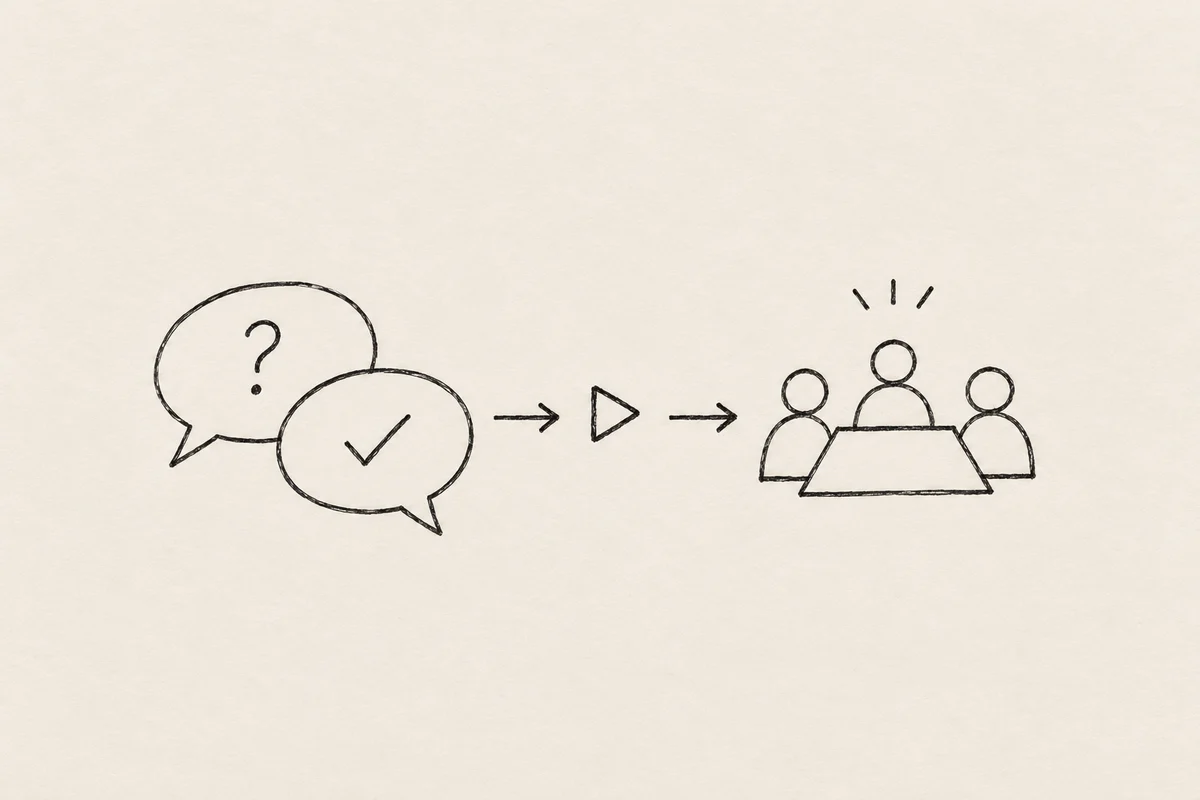
One episode struggles to explain an entire service category, demonstrate your approach, discuss the budget and secure an enquiry. People have different questions at different points.
| Viewer's situation | A useful video question | What should become clearer |
|---|---|---|
| Understands the problem but is not choosing a provider yet | Why has the familiar approach stopped working? | What needs addressing |
| Compares approaches | When does each option make sense? | Decision criteria |
| Assesses a provider | How do you investigate and make decisions? | Process and limits of expertise |
| Prepares to get in touch | What is the first stage, and what should I bring? | The next action |
This distinction reveals gaps. A channel may have dozens of useful tips and nothing explaining how an engagement begins. Alternatively, almost every episode asks people to book a call before helping them understand their problem.
A video can serve more than one purpose. The table helps identify its main job; it does not put viewers into a rigid funnel. People return, skip steps, receive recommendations and watch after making initial contact.
Show how you choose a solution
“An individual approach” tells viewers little. Showing which circumstances change your recommendation is more useful.
A fitness coach discussing home and gym training might examine available equipment, experience, the person's ability to train consistently and whether technique needs supervision. Medical limitations require an appropriate professional. The video explains the choice and the limits of a general answer.
A renovation company could compare ways to organise a project. A car-buying specialist could explain what information they need before an inspection. A manufacturer could show how intended use changes the choice of specification.
Conditions for declining work can also help. When is your service premature? When would a simpler solution suffice? What do you need before providing an estimate? Give concrete answers rather than performing generosity. They should help someone assess whether the offer fits.
Explain context before excluding viewers
Qualifying enquiries is reasonable. But “this video is only for companies with a large budget” may end a conversation before someone understands the work or their own needs.
In one analysis, Adam Chase links an early drop in viewing to a sentence restricting the audience by portfolio size. That is his interpretation of one video, not proof that qualification always hurts performance.
The narrower lesson is to decide when a boundary helps the viewer. If budget determines whether the service is feasible, hiding it until the end is inconvenient. You can first explain the scope and why it costs what it does.
For example: “This guide is for companies planning regular videos with preparation, filming and editing. If you need one phone-recorded video, some of these costs will not apply.” That gives a criterion for relevance without judging the person's importance.
First establish which explanations buyers repeatedly need. Use the guide to finding topics in customer conversations.
Build a small library for the sales team
You do not need a large education project to start. Select questions that already prevent a useful conversation. Record who needs each answer and when.
An illustrative library for a complex service might cover:
- choosing between handling the task internally and using a provider;
- understanding the budget;
- seeing what the first stage involves;
- examining a decision and its limitations;
- preparing the information and people needed for an enquiry.
This is not a required number of videos. Start with one repeated question if that is the problem. Split a complex explanation where viewers face separate decisions.
Give each video a short purpose statement: “Send after a price enquiry when the buyer is comparing different scopes.” If the team cannot explain who needs it, its role in the sale is not yet clear.
These videos can also be public. They may introduce new viewers through search and recommendations, while a salesperson shares them in an appropriate conversation. Consider those viewing contexts separately: someone following a personal recommendation may react differently from a first-time visitor.
Make the next step clear
After a video on choosing a provider, someone may need a service description, a related example or a list of information to prepare before completing a long form.
Describe what happens next. “Send your project outline and the materials you already have” is more specific than “grow your business”. List the information needed for an initial assessment before the person submits an enquiry.
Check the journey. Does the link work on a phone? Is the destination in the video's language? Are previously entered details retained? Can someone see who will respond and how? A useful video loses value when the next interface is confusing.
Agree how the sales team will use the library. Five unexplained links create work for the recipient. A short explanation is enough: “This shows what preparation includes. Afterwards, we can compare your current setup with the proposal.”
The guide to YouTube enquiries covers the wider path from viewing to contact. Here, focus on the next conversation and whether the task fits your service.
Check whether meetings become more useful
View counts alone cannot assess these videos. Nor can you credit them with every subsequent sale.
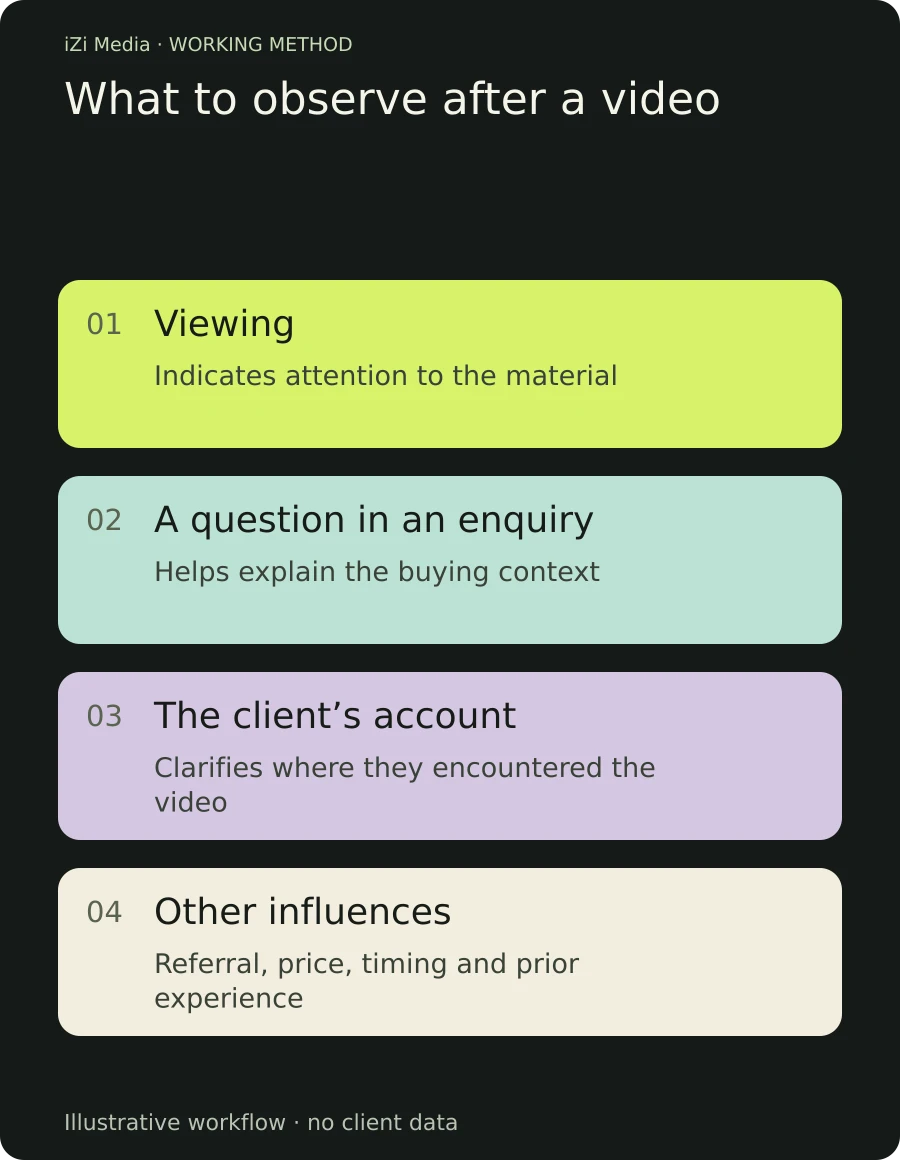
In contact notes, record which materials the person received, what they mentioned themselves and which questions remained. Keep the first known source of contact separately. Someone may discover you through a recommendation, watch the channel and return through search.
Choose observable questions for a trial:
| Intended change | What you can observe | What it does not prove |
|---|---|---|
| Repeat the service scope less often | Whether it needs explaining again | That the video shortened the whole sales cycle |
| Receive better-prepared enquiries | Whether relevant information is provided | That every viewer became a suitable prospect |
| Explain the difference more clearly | Which comparison criteria people use | That competing options became worse |
| Prepare the budget discussion | Whether expectations match the scope | That price stopped affecting the decision |
Compare similar enquiries. Different services, seasonal demand, a new salesperson or a price change may influence results more than a video.
Meeting length is ambiguous too. A short conversation might reflect preparation or a quick rejection. Assess the substance: did you reach the client's problem, establish constraints and identify a sensible next step?
Know when another format would work better
A pre-call video is useful when the explanation repeats and remains current. It is less suitable for private questions or information that changes constantly. Sometimes a document, diagram or personal answer is sufficient.
Do not require a long video to obtain a simple list. If someone is ready to discuss their situation, the library should not stand between them and a specialist.
There is another risk: a polished explanation creates expectations that the actual service does not meet. Review process videos against how the team works now. Changes to scope, approvals or the first stage may require updates.
I would start by examining repeated conversations and producing one useful video. Then check what clients understand better and what remains unclear. That experience provides a basis for a series without assuming that long-form video automatically sells a complex service.
To develop this kind of material for your business, discuss YouTube production. The first-episode enquiry case describes a separate project, whose result is not a forecast for your library.