A YouTube show pilot: what to test and how to budget a season
What to test before commissioning a season, how to review a pilot and how to break down costs. Includes a sample four-episode budget and criteria for continuing.
In this article (8)
Before commissioning a season, it helps to see one episode in production: how the host handles the material, what the guest does, whether there is enough action for the edit and how long preparation really takes. A pilot supports a decision to revise the format or continue. It cannot establish future views or sales.
This guide covers the test, acceptance and budgeting. The estimate below is illustrative: every rate is an assumption chosen to explain the arithmetic. It is not an iZi Media offer or a survey of Dubai prices.
Decide exactly what you are testing
A simple recorded rehearsal may be enough to check a conversation. If the interest depends on participants acting, demonstrating objects or moving between locations, test those elements. State the question first: can the guest explain a decision using specific material, are the rules understood, or can the team record the episode in the available time?
Distinguish an internal test from a publishable pilot. A test may examine one passage without finished branding. A publishable pilot goes through the agreed preparation, recording, editing, packaging and publishing. Their prices cannot be compared without the scope.
For “A decision under constraints” from the show development guide, you could first rehearse choosing between two options, then record a complete episode using permitted material. This is a teaching format, not an account of a released client season.
What must be ready before recording
| Document or decision | What it contains |
|---|---|
| Pilot question | The format property being tested and what would change the decision |
| Format document | Viewer, promise, mechanics, roles, fixed and variable elements |
| Episode plan | Scene order, questions, examples and essential shots |
| Participant preparation | Who attends, their understanding of the rules and what they can show |
| Production plan | Crew, location, time, equipment, access and fallback |
| Acceptance | Files, duration, captions, sound, revisions, approver and review date |
A format document is often called a format bible. Its length does not determine its usefulness. It should let a team prepare another episode without reinventing the rules. A small show benefits more from usable examples than pages of broad promises.
Agree material rights and publication boundaries separately: participants, third-party clips, music, documents and client locations. Record who obtains permissions and what is handed over. This guide does not replace reviewing the particular agreements.
Run the production test
Rehearse a short section before the full recording. The host introduces the situation, the guest responds, and the team tries the transition into a check or demonstration. This reveals whether instructions and material are ready. Introducing the main task to the guest for the first time on camera turns a preparation problem into filming time.
During the pilot, record why delays happen: a late participant, an unavailable document, lighting changes, an unclear rule or repeated answers. After editing, those notes help distinguish expensive mechanics from fixable organisation. One specialist can combine roles where that is agreed and practical.
The fallback should preserve the format’s substance. If documents cannot be disclosed, prepare an approved anonymised example in advance. If they are the central evidence and no substitute exists, change the subject or postpone. Do not depict a check that never happened.
What you receive after the pilot
The client receives the agreed finished material and a review: what worked in production, what needed reworking, which rules need clarification and the episode’s actual cost. For an internal pilot, the deliverable might be a test recording, edited passage and findings rather than a published programme. Define that before paying.
| Area | What to check | Possible decision |
|---|---|---|
| Promise | Viewers understand the reason to watch and receive the promised explanation | Clarify the subject, title or opening |
| Action | Rules are understood and participants have material that can develop | Simplify the mechanics or choose a different situation |
| Host | They clarify and move the conversation forward in a natural voice | Prepare again or change the role |
| Production | Actual hours and rework allow the format to be repeated | Revise schedule, crew or episode count |
| Continuation | More stories and participant access exist | Prepare a season, run another test or stop |
Feedback from acquaintances cannot establish future demand. Show a passage to people similar to the intended audience and ask what they understood and wanted to continue watching. This is qualitative feedback, not a representative study. A publicly available pilot adds YouTube data.
Review the pilot’s viewing data
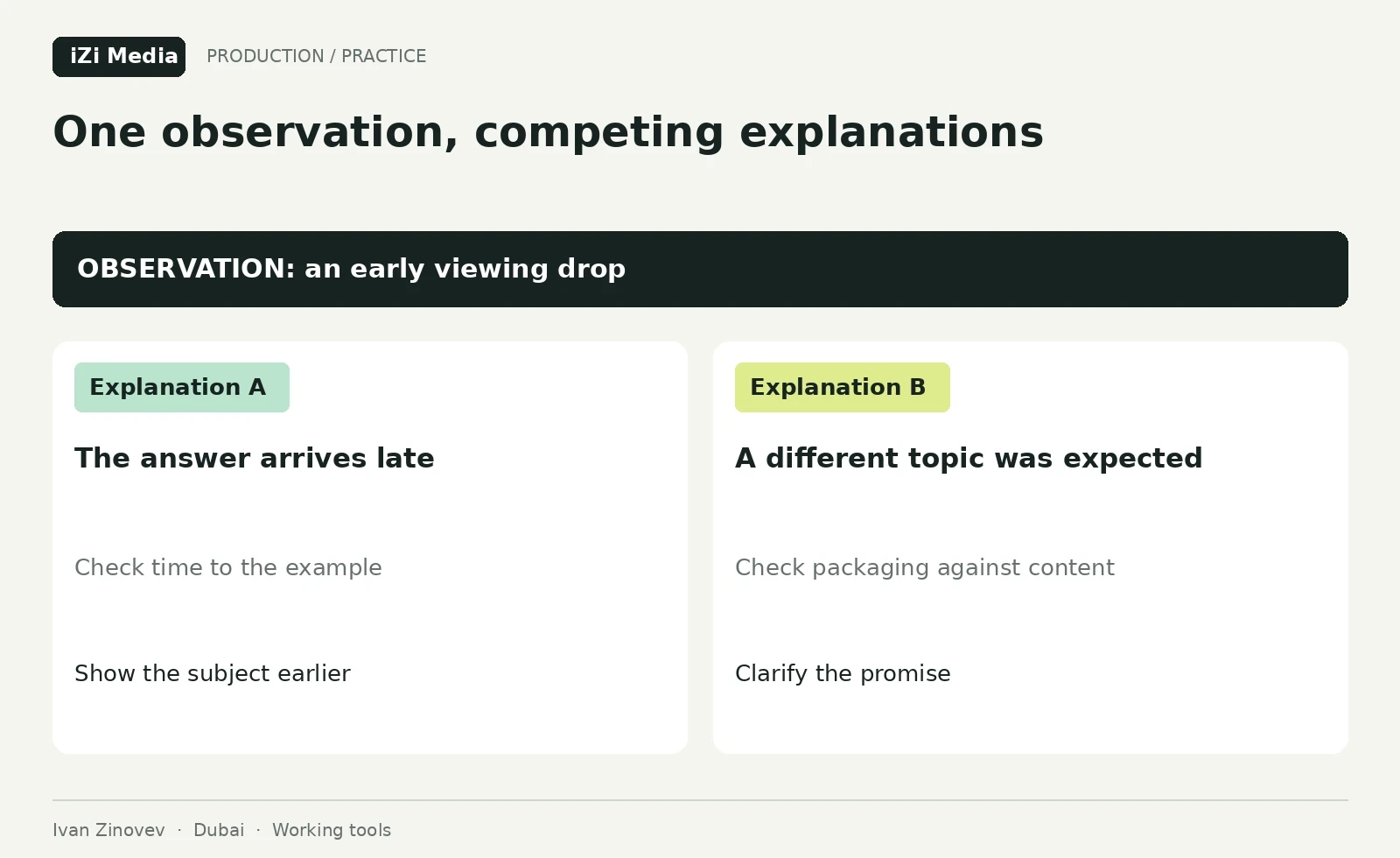
Open moment-by-moment retention and watch the passage where people leave. A bend in the graph alone cannot choose the edit. Traffic source, title expectations and scene content support different explanations.
YouTube’s impressions guidance describes the connection between impressions, opening and viewing. Compare episodes at similar publication ages and within the same traffic source. Record limited evidence and keep observing a small new channel. An absence of reliable signals does not establish success or failure.
An eligible published video can use the available built-in title and thumbnail test. That concerns packaging. It cannot test the entire format, the host’s work or the season’s economics.
Build the season budget
Separate one-off work from episode costs. Format development, initial design and workflow setup may be needed at the start. Story preparation, participants, recording, editing and publishing recur. A new location, language or demanding demonstration changes the estimate.
A useful structure is one-off work + episode preparation + filming days + location and equipment + post-production + publishing + agreed contingency. Remove costs already included elsewhere. If a studio quote includes equipment and an operator, do not count them twice.
An illustrative four-episode estimate
Assume one host, one language, one location, four conversation episodes of roughly 25–35 minutes, two filming days and 30 short versions. Participants charge no fee, there is no travel and graphics are simple. The pilot is one of the four episodes. The invented rates illustrate budget lines; they are not market rates.
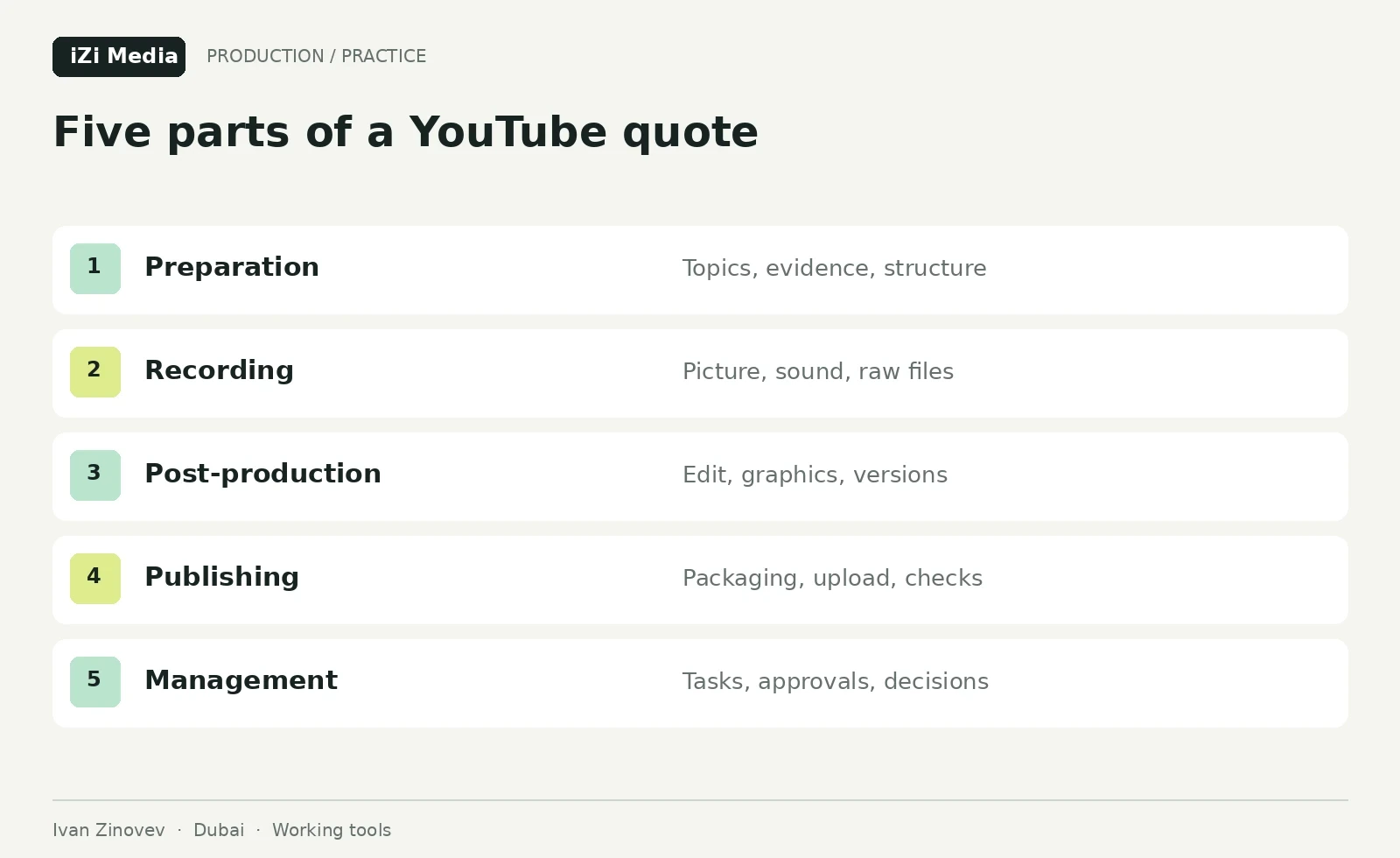
| Work | Calculation | Assumed amount, AED |
|---|---|---|
| Format development | One stage | 4,000 |
| Editorial preparation | 4 × 1,500 | 6,000 |
| Filming crew | 2 days × 3,500 | 7,000 |
| Location | 2 days × 1,500 | 3,000 |
| Long-form editing | 4 × 2,000 | 8,000 |
| Short versions | 30 × 150 | 4,500 |
| Titles and thumbnails | 4 × 350 | 1,400 |
| Publishing and review | Agreed scope | 1,600 |
| Subtotal | Sum of lines | 35,500 |
| Contingency in this example | 10% × 35,500 | 3,550 |
| Total with contingency | 35,500 + 3,550 | 39,050 |
Ten per cent is a teaching assumption. The contingency amount and its use depend on risks and agreement. Tax, participant fees, additional equipment, translation and travel are excluded here; check their applicability and amounts in the real proposal. Contingency does not replace approval for additional work.
If the pilot is not accepted as a season episode, identify which development and recording outputs can be reused and which need reworking. Dividing the pilot cost by four is misleading: some setup happens once, while other costs repeat in full.
What “from AED 15,000” means on my website
The show service retains a starting reference for an agreed working format with four episodes and 30 short versions. It is not a universal budget for every show, a separate fixed concept fee or a promise to cover all external expenses within that amount.
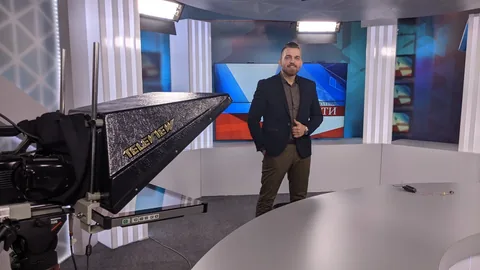
Concept development and a pilot can be commissioned separately. A season proposal defines my role, the crew, deliverables, timing and included work. Check studio, camera crew, equipment, guest fees, logistics, language versions and material rights as separate lines. The teaching estimate above has its own assumptions and does not describe that service reference.
Use the complete production cost guide to compare teams. Keep volume and finished deliverables the same. A polished pilot, a filming day and a finished season need different estimates.
Commission the season, revise the format or stop
Continuation becomes more reasonable when the rules work, further stories exist, the host handles the role and production fits the time and budget. Audience outcomes still need observation. You can commission stages so that continuation decisions follow finished material.
If the story is clear but filming is too complicated, simplify the location or action. If production runs smoothly but viewers cannot tell what to follow, revisit the promise and mechanics. If the core material depends on access you cannot secure, stopping may be wiser than another filming day.
Write a specific decision: what stays, what changes, who owns it and when it will be reviewed. The channel-launch case study describes organising first videos. For your project, discuss a concept, pilot or season.